



5 Reasons Why Bali Remains a Top Property Investment Destination

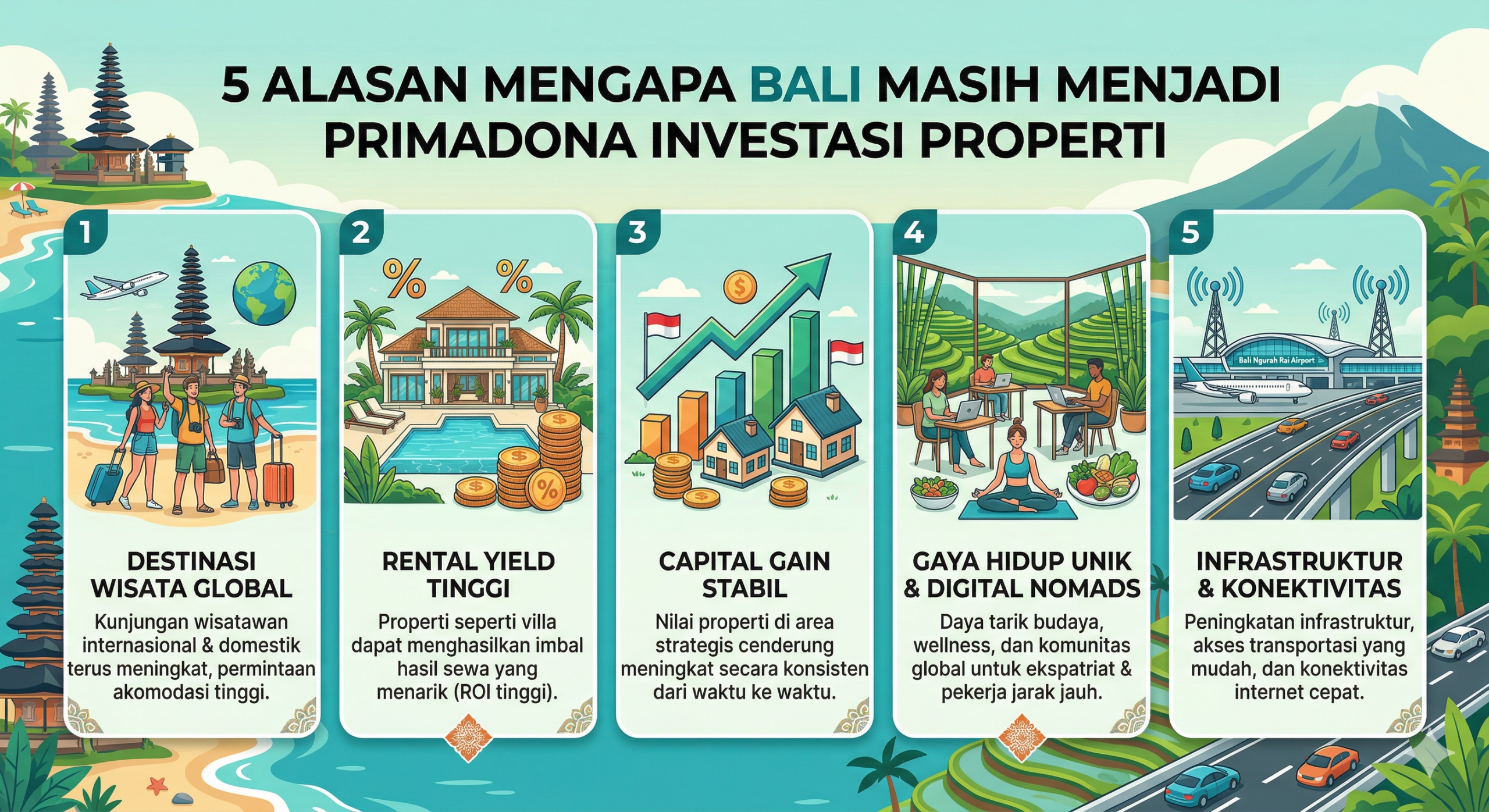
5 Reasons Why Bali Remains a Top Property Investment Destination
Bali has long been celebrated as a global tourism hotspot, but over the last few years, its identity has shifted. It is no longer just a place for a two-week holiday; it has evolved into a premier destination for long-term living and lucrative real estate investment.
For property investors—whether seasoned veterans or first-time buyers looking to diversify their portfolios—the “Island of the Gods” continues to offer unmatched potential. If you are analyzing the market in 2026, here are the five core reasons why Bali property remains a highly sought-after asset.
1. Exceptionally High Rental Yields
One of the most compelling arguments for investing in Bali is the return on investment (ROI). Compared to major capital cities across Southeast Asia, Bali’s property market offers significantly higher rental yields.
-
Short-Term Holiday Rentals: Villas in high-traffic areas (like Seminyak, Canggu, and Uluwatu) can generate daily rental rates that result in an annual yield of 8% to 15%, depending on management and occupancy rates.
-
Long-Term Leases: With the influx of expats and remote workers, there is a massive demand for yearly rentals. While the yields are slightly lower than daily rentals, they provide stable, guaranteed cash flow without the high turnover costs of short-term guests.
2. The Unstoppable Digital Nomad and Remote Work Boom
The global shift toward remote work has fundamentally changed Bali’s demographic. The island is consistently ranked as a top global destination for digital nomads, driven by favorable visa regulations (such as the Second Home Visa and remote worker visas).
This demographic does not want to stay in traditional hotel rooms. They are looking for fully equipped properties that offer:
-
Dedicated workspaces with high-speed fiber-optic internet.
-
Proximity to co-working spaces and international networking hubs.
-
Long-term lifestyle amenities, including access to reliable nanny services, international schools, and health food cafes.
Investing in properties that cater specifically to this long-term, remote-working crowd guarantees a steady stream of premium tenants.
3. Continuous Infrastructure Development
A key indicator of a healthy property market is government and private investment in local infrastructure. Bali is continuously upgrading its facilities to support its growing population, which in turn drives up property values.
-
Healthcare: The development of international-standard medical facilities, such as the Bali International Hospital in Sanur, provides peace of mind for expats and retirees.
-
Accessibility: Ongoing improvements to toll roads, alternative traffic routes, and the expansion of the Ngurah Rai International Airport make the island more accessible than ever.
4. Diverse Micro-Markets for Every Budget
Bali is not a monolith; it is a collection of distinct micro-markets, allowing investors to choose a strategy that fits their capital and risk tolerance.
-
The High-Demand South: Areas like Canggu and Uluwatu are high-entry-cost markets, but they offer immediate, aggressive cash flow and high occupancy rates.
-
The Emerging East and North: For investors looking for lower land prices and long-term capital appreciation, regions like Amed in East Bali are becoming incredibly attractive. As tourists and expats seek out quieter, culturally rich environments away from the southern traffic, these emerging coastal villages are seeing a surge in demand for boutique villas and eco-resorts.
5. Strong and Consistent Capital Appreciation
While rental yields provide the cash flow, capital appreciation builds long-term wealth. Despite global economic fluctuations, land values in Bali’s desirable areas have shown a historical trajectory of robust growth.
Because the island’s geography physically limits sprawl—bordered by the ocean and defined by protected green zones and volcanic terrain—prime, buildable land is a finite resource. As demand continues to outpace supply in popular coastal corridors, property values naturally increase, securing your initial investment.